
How does human activity influence the brightness of clouds?
How do human emissions of small particles, e.g. smoke from motors and industry, influence the brightness of clouds? It is clear that greenhouse gases increase the earth's temperature. But solid and liquid emissions (aerosols) are thought to cool the earth by changing cloud properties. However we don't know exactly how big this cooling is. It is hard to establish to what extent aerosols cause changes in cloud properties. This is because there are other factors such as humidity that may influence both aerosols and clouds (these other complicating factors are called confounders).
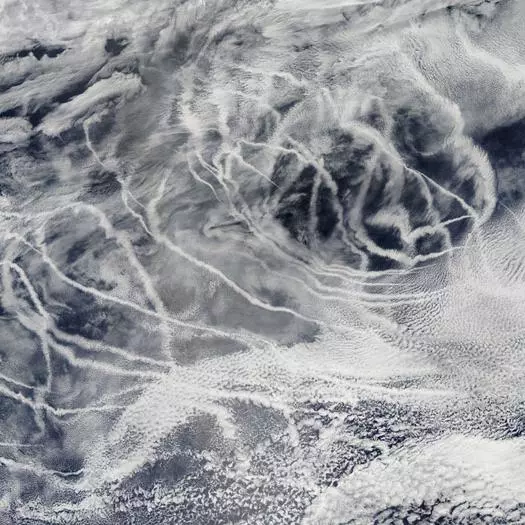
To exclude confounding this project focuses on ship tracks - the cloud trails left behind by the passage of ships. For water vapour in the atmosphere to turn into liquid water and form clouds, it needs particles to condense on. Where ships emit aerosols, more particles are available for condensation. This means that clouds here tend to have more droplets. And a higher droplet number leads to more scattering of light, i.e. a brighter cloud. We propose a new method, which follows the path of shipping emissions over several hours and studies the properties of clouds in these locations. Comparing with a nearby location without emissions allows us to separate out the aerosol effect.
Climate models predict that the climate-cooling effect from shipping should be large. But satellite studies only find small effects. Resolving this contradiction will make modelling more precise and give better predictions of future climate change. This has important consequences for policy makers' efforts to curb greenhouse gas emissions.