Skip to main content
Plain-language summaries
Sharing our research with a wider audience
Can computer models help to capture the lifecycle of clouds?
Solving climate data challenges using deep learning
Can machine learning help us to discover more about clouds?
Recreating cloud properties using statistical models
Can neural networks improve the accuracy of satellite data?
Overcoming the limitations of satellite data using computing systems inspired by the human brain
Can observations be combined to better understand aerosol-cloud relationships?
Obtaining better measurements of the state of the atmosphere
Can patterns over time help to determine cause and effect relationships in climate models?
Investigating multiple time-series within a causal inference framework
How can clouds be described more accurately?
Developing a robust method of cloud classification for objective analysis
How can we investigate what's happening inside clouds?
Discovering how stratocumulus clouds form and develop in response to aerosols
How do aerosols affect marine clouds?
Reducing uncertainty in future climate projections
How do clouds and rainfall adjust the tropical atmosphere?
Analysing aerosol size and concentration in South America
How does human activity influence the brightness of clouds?
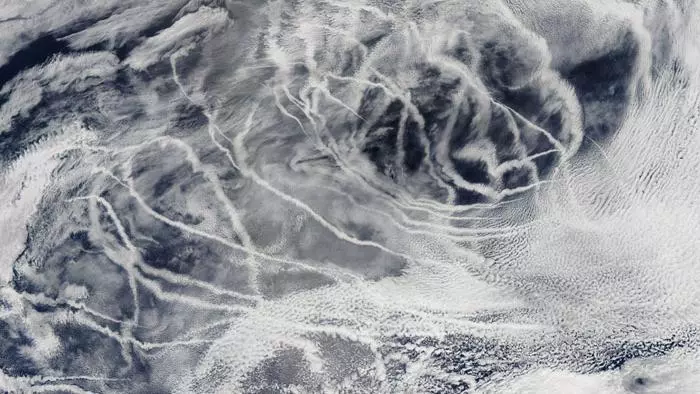
Using ship tracks to look at the reflective properties of clouds
How much atmospheric change is due to human aerosol emissions?
Using machine learning to isolate the effects of aerosols and greenhouse gases
What's so special about Arctic clouds?
Understanding how aerosols drive cloudy and clear sky conditions in the Arctic
What's the connection between volcanic emissions and cirrus clouds?
Understanding the formation of high altitude ice clouds
Which factors influence changing climate?
Determining cause and effect in climate science